Mountain airstrips
Mountain airstrip
of Escoulin (LF2624)
It is said that the Escoulin mountain airstrip was created so that the Allies could support the French Resistance forces (FFI) in the Vercors massif during the Second World War.
The Vercors massif is a roughly triangular plateau, up to 60 km long from north to south and up to 40 km wide. Only a few roads climb the steep slopes up to the massif, and the population lives in a handful of small villages. The porous limestone and karst terrain have created a vast network of caves and caverns. The maquis used the plateau as a refuge.
From 1942, the Service du Travail Obligatoire (STO, compulsory labour service) led to the deportation of hundreds of thousands of young Frenchmen to Nazi Germany to work as forced labour for the German war effort. To escape the STO, tens of thousands of men fled into the mountains and forests of France and joined the maquis, the rural resistance fighters battling the German occupation. The Allies supported the maquis by parachuting weapons and providing teams of advisers and trainers. The Vercors massif became an important base for such operations.
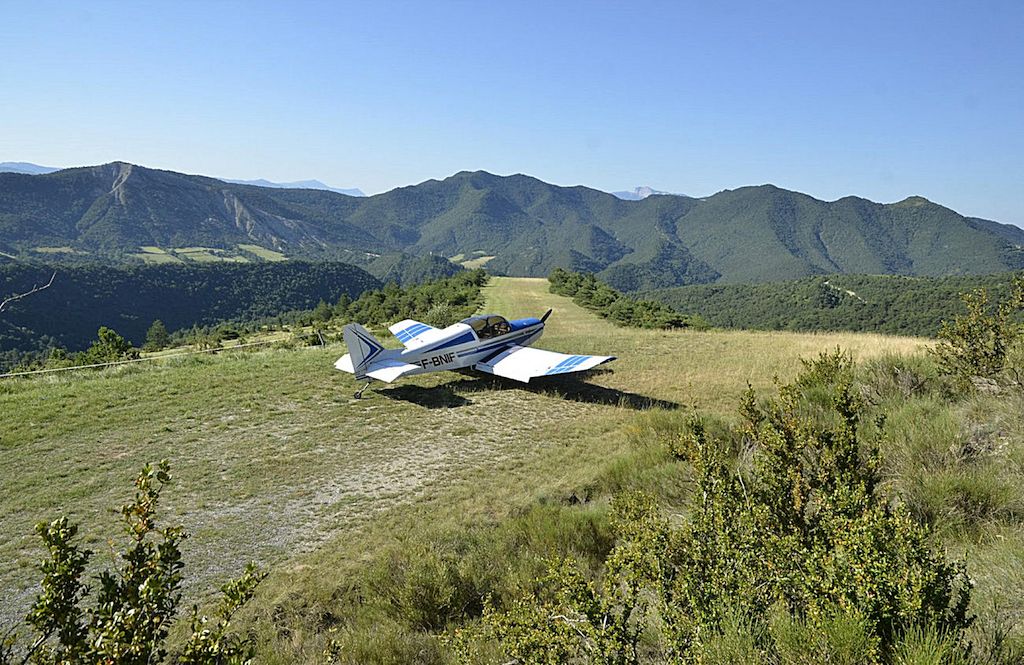
In August 1943, Francis Cammaerts, code name Roger, an agent of the British Special Operations Executive (SOE), went to the Vercors and met the French soldier Eugène Chavant. Cammaerts organised the SOE's first airdrop of weapons and supplies to the Vercors maquis on 13 November 1943. On 6 January 1944, a three-man “Union” mission, including US Marine Peter Ortiz of the American Office of Strategic Services (OSS), Colonel Pierre Fourcaud of the French secret services and Harry Thackthwaite of the SOE, came to assess the capabilities of the Resistance in the French Alps. Together with Cammaerts, they organised, trained and armed the Vercors maquis to prepare it for an important role supporting the Allied invasion of southern France. By June 1944 the maquis numbered about 4,000 fighters and proclaimed the Free Republic of the Vercors. The Escoulin airstrip is said to have served as a landing site for British Lysander aircraft carrying men and equipment for Allied support to this force.
On 8 June 1944, Marcel Descour, regional head of the French Resistance, ordered François Huet, the new commander of the Vercors maquis, to mobilise. Huet objected that he had neither the men nor the weapons to defend the Vercors, but Descour assured him that the Allies would send reinforcements. The German response was to mount one of their largest anti-resistance military operations in France during the Second World War. Losses among the maquis during the battle were heavy, with an estimated 659 resistance fighters and 201 civilians killed.
– J. L. Crowley
See: https://en.wikipedia.org/wiki/Battle_of_Vercors