
Our history
Grenoble-Eybens
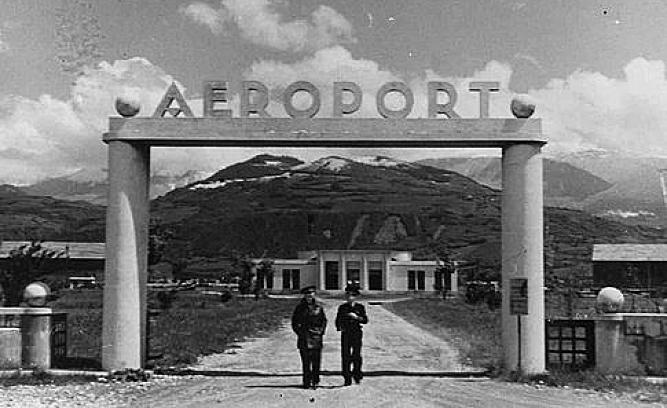
Grenoble-Eybens airport opened in 1936 on the farmland of Échirolles, under the name Jean Mermoz, with a grass-only airfield. Its management was entrusted to the Grenoble Chamber of Commerce. The ACD was the aerodrome's only user, with Mr Guenon as chief pilot and four aircraft provided by the State.
The ACD's activity came to an abrupt halt when the army requisitioned all its aircraft at the start of the Second World War in 1939. Several French military squadrons passed through Mermoz airport on their way to the north-eastern front. The “Battle of France” (September 1939 to June 1940) ended in defeat, but Grenoble remained in the so-called free zone, governed by the Vichy French State.
A point of local history: a decree of August 1941 created the École des Pupilles de l'Air (EPA) to look after the orphans of airmen killed in the Battle of France. Originally located on the Grands Boulevards in Grenoble, it later moved to Montbonnot in December 1986.
During the Vichy period (1940-42), the airfield changed dramatically with the forced construction, imposed by the Germans, of two concrete runways of about 1,000 m, crossing each other along the prevailing winds. These runways were never used during the Italian and German occupations (1942-44), not even for the fighting in the Vercors.
As for civil flying, although powered flights were strictly forbidden, the ACD's gliding activities began in October and November 1942 with four “boom” gliders (Avia 151 and 152) and one “fuselage” glider (Castel 30) provided by the State air sports service.
This brief burst of activity was halted by the start of Operation Torch on 8 November 1942, when the Allies landed in North Africa and, in response, the Axis forces invaded the free zone. Mermoz airport came back to life in autumn 1944, at the Liberation, with the American military Piper Cubs moving up from the south after the landings in Provence on 15 August 1944, followed by the French aircraft of Group 1/35 “Aviation des Alpes”, engaged in the “Battle of the Alps” on the Italian border until April 1945.
The ACD resumed its activities after the Liberation in two stages, depending on the type of activity and on government authorisations: from autumn 1944 with the Avia boom gliders stored since 1942, followed in 1946-47 by “real” mass-produced French gliders (Nord 1300, Émouchet and Castel 301 single-seaters, Caudron C-800 two-seat trainers), all provided free by the official services (SALS). Old-timers will remember their glide ratio of about 10, compared with 40 to 60 for today's gliders! Powered flying resumed in spring 1946, when civil flights were allowed again – here too with equipment provided by the State, the first aircraft being a Bücker 181, a former Luftwaffe liaison aircraft taken as a “war prize”.
This was the heyday of the first multi-role Stampe biplanes: training, aerobatics, glider towing. The 1950s brought a mixed fleet of aircraft: Storch and MS-315 tugs, NC-853 basic trainers, all provided by the State, plus a few aircraft bought by the club, including the Norécrin, Auster, Sokol and the giant six- or seven-seat De Havilland Dragon twin. ACD gliding, regarded as a regional centre, received a dozen so-called performance gliders (Castel 310, 311, Nord 2000, Milan, Air 102, Bréguet 901). In the mid-1950s the fleet grew and became more uniform, especially for basic training, with the purchase of 65 hp Piper Cubs for training and 65 hp Jodel 112s for touring.
From 1954, gliders were registered F-C… and handed over to the club free of charge. This marked the beginning of the State's withdrawal from supporting light aviation. Performance gliding developed with the first discoveries of wave flying, marked by the first double crossing of the Alps (Grenoble–Turin) by Perrier and Poncet in April 1955.
At the end of the 1950s, chief pilot Henri Giraud began the great adventure of mountain flying with the first landing on Mont Aiguille in the summer of 1957, in an ACD 65 hp Piper. He repeated the feat, this time on the summit of Mont Blanc, on 23 June 1960, in the 150 hp Piper “Choucas” of the mountain rescue service – an achievement that left an indelible mark on the ACD's DNA.
The first Mousquetaires appeared in 1960. 1961 saw the arrival at the ACD of the first Robins (still with tailwheels), the natural successors to the two-seat Jodels. Training also evolved with the arrival of the first Rallyes in 1962.
In the 1960s, a serious internal crisis shook the club. Henri Giraud kept his post, while the long-standing President P. Matussière, one of the founders of the ACD in 1928, was ousted. Most of the glider pilots then left for Romans. As a result, the club lost its status as a regional centre and the official services withdrew the two high-performance gliders (Air 102 and Bréguet 901).
What came next: the Grenoble Winter Olympics (1968).
Back to Our history.