
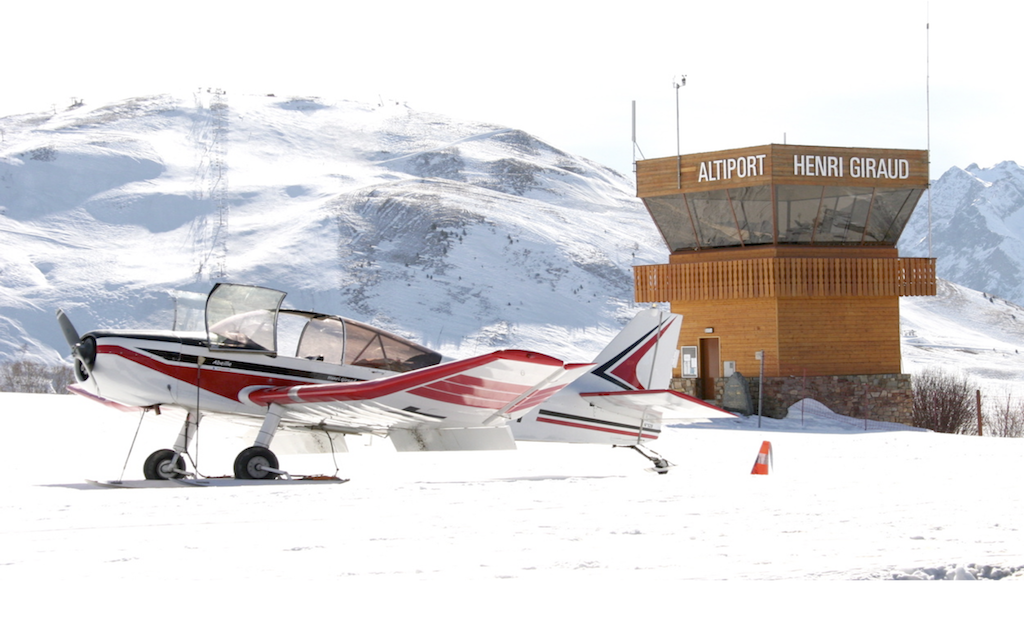
Mountain flying on skis
Sharing the slopes
with skiers
In recent years, conflicts between skiers and mountain pilots on mountain airstrips and glaciers have become more frequent.
Sharing the mountains with skiers and walkers
A growing number of skiers feel the need to escape the very constrained environment of the resorts and head off into ski touring and off-piste skiing. At the same time, a growing number of pilots reach a level where they can land on snow in the high mountains. So we are inevitably on collision courses… And the environmental mood is not in our favour. We mountain pilots must first of all show courtesy. When four or five Mousquetaires circle over a glacier, with three or four landings per crew member, the noise of our engines – at full power on take-off, or even at half power during reconnaissance – echoes off the valley walls and must greatly irritate the brave souls who reach the glacier after hours of climbing by headtorch… The AFPM (Association Française des Pilotes de Montagne), rightly very aware of the impact of our activity and the nuisance it causes other mountain users, passes on the following recommendations:
- Two landings maximum per mountain airstrip (only one at Saint-Jean-d'Arves, according to the latest news!)
- Three landings maximum per glacier AND only three aircraft in the circuit at the same time.
- On the Mont Blanc massif and other places with many ski tourers, avoid the 11:00–13:00 slot, a favourite time for picnics and/or the end of guided tours.(*)
The AFPM is currently working on an update of the reconnaissance method to reduce its noise impact. But every pilot must be fully aware of their responsibility. Anything that non-pilots may see as inconsiderate threatens, sooner or later, the future of mountain flying. We are all concerned, and we sometimes see completely unacceptable behaviour, especially during the winter school holidays, when leisure flights multiply.
Collision risks

In this photo (taken from the video shot by Éric Vuillermoz while landing on the Dôme de la Lauze, a wingbeat away from La Girose), the red dot marks the touchdown point. We are crabbing slightly because of the crosswind. You are at the controls. Suppose skiers appear at the top of the dome (the blue dots) at that very moment.
Even if they have seen you, they will not necessarily imagine that you are going to land on this steep slope. They have no idea of your speed (at least 140 km/h at touchdown), no idea of what you are going to do.
You do not know whether they have noticed you. You do not know where they are going or how they will tackle the slope. Once landed, you will have very little control over your path. All the ingredients for a disaster are there. Even if during reconnaissance you feel “it will be fine”, in the time it takes to fly the circuit and line up, the respective positions can change very quickly.
An old saying: “If you are asking yourself whether to go, you shouldn't go.”
Credit: Bernard Moro