Mountain flying
Mountain rating
skis
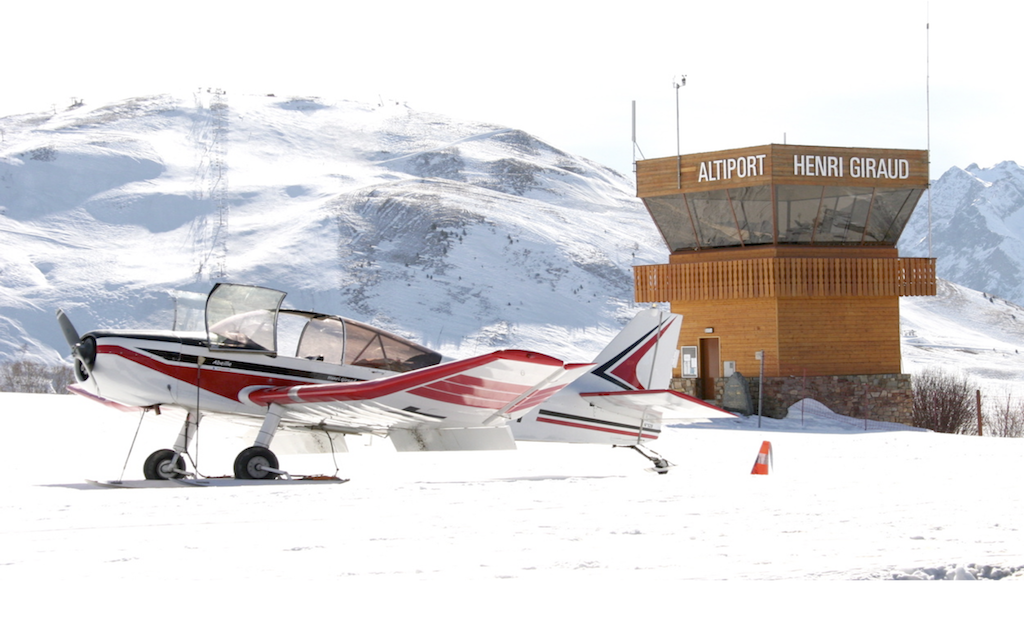
A special rating that allows pilots to land on snow-covered altiports and mountain airstrips with ski-equipped aeroplanes.
The training programme for the additional mountain rating (skis) is similar to the programme for the additional mountain rating (wheels). However, operating ski-equipped aircraft on snow-covered surfaces requires an extra level of experience and maturity to judge whether surface conditions allow a safe landing, taxiing and take-off.
The pilot must have the experience needed to recognise whiteout conditions, which make it impossible to judge the distance to a snow-covered surface.
When landing on a mountain airstrip or an altiport, the pilot must be able to recognise “sticky snow” surface conditions, which can cause excessive braking on landing and prevent the aircraft from accelerating to rotation speed on take-off, as well as ice-covered snow, which can cause excessive sliding in the parking area.
A pilot landing on a glacier within 48 hours of a heavy snowfall must be aware of the danger of triggering an avalanche. Pilots must be aware of the danger of skis sliding under a hard surface crust, causing the aeroplane to stop abruptly and flip over on landing. Pilots must also be aware of the dangers of crevasses and of skiers or walkers in the landing area.
See Bernard Moro's advice on the dangers of operations on snow-covered surfaces and on sharing the slopes with skiers.
Entry requirements
Prerequisites for starting mountain training:
- Hold a valid LAPL, class 1 or class 2 medical certificate in accordance with PART MED A.030
- Hold a PPL(A), CPL(A) or ATPL(A) licence with a valid SEP(T) class rating, or
- Hold a LAPL(A) licence meeting the recent experience requirements of FCL.140.A.
- Hold the differences training required for the aircraft used
Objectives of mountain flying training
The objective of mountain flying training is to train pilots to the level of competence needed to operate an aeroplane safely to and from surfaces for which the authorities designated by the Member States consider such a rating necessary.
This mountain flying training must enable pilots, in complete safety:
- To navigate among the relief, taking the environment into account
- To decide whether to use – or not to use – an altiport or a mountain airstrip and to choose the landing parameters, after a detailed analysis of the environment
- To fly paths and speeds that allow a safe landing.
- To carry out a safe take-off
This training programme is competency-based
Technical skills
- Handling (PIL): flying and controlling the aeroplane's primary parameters (heading, speed, altitude, vertical speed) using pre-set values.
- Flight path (TRA): designing, visualising and following a flight path through key points.
- Procedures (PRO): applying all the procedures in force for preparing and conducting the flight.
- Communication (COM): understanding others and making yourself understood without ambiguity.
- Knowledge (CNS): all the knowledge needed to carry out the flight.
Non-technical skills
- Situational awareness (COS): the pilot is aware of all factors, such as traffic, weather, fuel, the state of the aeroplane and their own fatigue, that could affect the success of the training scenario.
- Decision-making (DEC): the pilot makes appropriate decisions in good time, based on the tasks to be carried out, in-depth knowledge and the use of all available resources.
- Workload management (GES): the pilot prioritises and selects the most appropriate tasks (or series of tasks) to ensure the success of the training scenario.
Training programme
Theoretical knowledge
- Equipment
- Take-off and landing techniques
- Regulations
- Meteorology
- Human performance and limitations
- Navigation
- Specific items
Flight instruction
- Handling and navigation in the mountains
- Arrival, reconnaissance and choice of reference points
- Approach and landing
- Ground manoeuvres and parking on snow.
- Take-offs
As training follows a CBT approach, there is no set number of hours to obtain an additional mountain flying rating.